
Comparison
Linearity vs Claude Design:
editable vector files or HTML
Ask both for a campaign. Claude writes code you still have to turn into a design. Linearity hands you the layered vector file.



The short version
Both turn a prompt into a design. Claude gives you a webpage. Linearity gives you a real design.
Real vector files
Layers, paths, and live text. Not a coded page.
On-brand by default
Fonts, colors, and logos enforced, not suggested.
Every channel in one click
Resize and localize without redoing the work.
Localized in your voice
Tone of voice carried into every language and channel, automatically.
Same prompt, different output
One prompt. Two very different things to hold.
Same brief, similar design. What you get back is the difference.
Claude Design
A coded web page
- ✕HTML, CSS, and JavaScript
- ✕Edits happen in the browser
- ✕No layers panel or vector paths
- ✕Leaves as PDF, PPTX, or Canva
Linearity
The design file itself
- ✓Named, editable layers
- ✓Real vector paths and live text
- ✓Resizes to every channel
- ✓Print-ready with CMYK and bleed
Side by side
Linearity vs Claude Design, feature by feature
Where each tool stands today. Claude is strong at building web designs. Linearity is built for the work that ships: editing, brand control, and every channel.
| Features | Linearity | Claude |
|---|---|---|
| Editable layered file Open the result and change any element directly. | ✓ | Via Figma or Canva export |
| Real vector paths and live type Scales from a social post to a billboard with no quality loss. | ✓ | ✕ |
| Print-ready export SVG, PDF, and PNG straight from the canvas. | ✓ | PDF and PPTX |
| Pixel-perfect manual control Nudge, align, and fine-tune by hand when it matters. | ✓ | Spacing and color knobs |
| Icons and vector illustration Draw, edit, and reuse icon sets inside the file. | ✓ | As code, not a file |
| AI image editing Background removal and upscaling on the canvas. | ✓ | ✕ |
| Brand | ||
| Brand kit with fonts, colors, and logos Load your brand once, every generation starts inside it. | ✓ | From codebase or design files |
| Locked styles and governance Templates and rules nobody can accidentally break. | ✓ | ✕ |
| Off-brand output flagged before it ships Which color drifted, which logo placement breaks the rules. | ✓ | ✕ |
| Brand rules, not just tokens Logo lockups, clear space, and tone of voice. | ✓ | Colors, type, components |
| Speed and iteration | ||
| Prompt to first design in seconds | ✓ | ✓ |
| Iterate by conversation Refine with follow-up prompts. | ✓ | ✓ |
| Iterate by hand Grab the headline and retype it. Drag the logo. Done. | ✓ | In the browser |
| Resize to every channel One design becomes posts, stories, ads, email, and slides. | ✓ | ✕ |
| Localize campaigns Copy, layout, and tone of voice adapt per market. | ✓ | Text only, per prompt |
| Teams | ||
| Shared workspaces | ✓ | Projects, chat-based |
| Approval workflows Draft, review, approve. Nothing ships by accident. | ✓ | ✕ |
| Roles and permissions | ✓ | Org admin only |
Based on publicly documented capabilities of both products, August 2026.
Editability
A file you can open. Not a draft you describe.
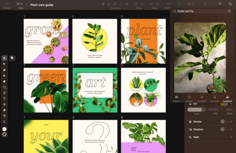
Claude Design lets you edit text inline and nudge spacing with live controls. What you are editing is a web page. In Linearity you are editing a design file.
- ✓Named layers you can select, move, and reuse
- ✓Live type you recolor and restyle in place
- ✓Vector paths you reshape, not markup you re-render
Claude
Linearity
- Headline
- Logo
- Shapes
- Background
Brand control
Your brand is a rule, not a suggestion.
Claude Design extracts a design system from your code: colors, type, components. Those are UI tokens. Linearity models the whole brand, including logo lockups, type scales, tone of voice, and the rules that govern them, then applies it to every asset without being asked and flags anything that drifts.
- ✓Modeled from your guidelines, not scraped from code
- ✓Applied to every generation with nothing to prompt
- ✓Drift flagged with the reason, before anything ships
Brand kit
Product launch,
on brand.
Applied without being asked
No brand reminder in the prompt, no pasted hex codes. Every generation starts inside your system.
Locked templates and styles
Brand teams lock what must not move. Everyone else fills in the rest.
Roles, permissions, approvals
Draft, review, approve. Nothing reaches a channel unreviewed.
Brand drift caught before it ships
Off-brand output gets flagged with the reason. Wrong color, faint headline, bad logo placement.
Consistency across hundreds of assets
One brand across a whole campaign, in every format and market.
Deeper than a design system
Logo lockups, type scales, tone of voice, and brand rules. Not just the tokens sitting in a repo.
A chat can be told your brand. A design engine can enforce it.
One is a prompt you hope everyone remembers. The other is a system nobody can accidentally break.
Claude Design, honestly
What Claude does well, and where it hands off
Claude is strong at design for a generalist. It reasons about layout, explains its choices, and writes the code. What it does not have is your taste. It falls back to its own.
Conversational design
Describe a direction in plain language and get a solid draft back, with the layout reasoning explained.
You refine by talking, commenting, and nudging live controls. It is a page you are shaping, not a canvas.
Works in HTML
Claude writes HTML and component code, and can read a design system out of a repo.
That is markup, not design. Linearity works in design elements: layers, type, and shapes you edit on a canvas.
Documents and decks
Decks, internal docs, and PDF or PPTX exports come out fast and read well.
A deck is not a campaign. No resize, no localization, no production file.
Copy and concepting
Excellent at campaign copy, naming, and pressure-testing a brief.
Bring that copy into Linearity and it becomes finished, on-brand assets.
Claude drafts. Linearity produces.
Craft
Designed, not generated
Every model has a house style it falls back to, and asking for something different usually swaps one default for another.
- ✓Generated inside your brand, not a model default
- ✓Illustration and shape work that holds up at any size
- ✓A campaign that looks related, not repeated
A default look
Your brand
Scale
One prompt. Every channel. Every market.
A campaign is never one image. Claude gives you one artifact per chat. Linearity fans one design out to every format and language you ship in.
- ✓Instagram, LinkedIn, ads, email, and slides from one design
- ✓Layouts reflow to each ratio, no manual cropping
- ✓Tone of voice adapts per market, not just the words
- ✓Localize copy and layout in a few clicks
Summer Sale
Up to 40% off
Screens and print, one file
Claude Design exports PDF and PPTX. Neither is a production file, so a printer cannot run them as they are.
- ✓Vector output, sharp at any size
- ✓Bleed, crop marks, and CMYK on export
- ✓Business card to billboard from one file
Summer Sale
Up to 40% off
Which one is for you
Should you use Claude or Linearity?
Different jobs. If you are weighing a Claude Design alternative for marketing work, here is where each one wins.
Choose Claude when
For thinking, drafts, and documents.
- Exploring rough directions in a chat
- Slide decks and one-off internal docs
- Your visual language lives in a codebase
- A draft is good enough
Choose Linearity when
For work that ships.
- Every asset matches your brand
- Fine-tune by hand: text, color, layout
- One design, every format and market
- Team approvals and locked templates
Plenty of teams use both. The better setup is to run Claude on your brand system rather than beside it.
Brand layer
Or run Claude on your brand
Linearity holds the brand system. The tools your team already uses can generate against it instead of their own defaults.
- ✓Logo lockups, type scales, tone of voice, and brand rules
- ✓Reachable over MCP on Enterprise
- ✓On-brand export and export permissions
Your brand system
Linearity AIFAQ
Still deciding?
Linearity Vector 1.0, a model we built ourselves. It generates structured design files with live text, brand colors, and real layers, rather than flat images or markup. Read about Linearity Vector 1.0
Claude is an AI assistant that generates design. Drafts come out well, but editing means re-prompting and finishing usually moves to another tool. Linearity does generation, editing, and publishing in one place.
Yes. Import Claude's PDF export, or paste your original prompt into Linearity to regenerate it as an editable vector file with your brand kit applied.
Both start from a plain-language prompt, so neither needs design skills to begin. The difference shows when something needs changing: in Linearity you click the thing and change it, instead of describing the change and hoping the regeneration keeps everything else intact.
In Claude, your brand is whatever you remembered to paste into that conversation. In Linearity, your brand is loaded once as fonts, colors, logos, and rules, then enforced on every generation, with locked templates, approvals, and off-brand output flagged before it ships.
For marketing work, yes. Claude Design is strong at building web designs and shipping them as HTML, PDF, or PPTX. Linearity generates editable vector files that stay on-brand, resize to every channel, and export production-ready for print.
Claude's design features are bundled into Claude Pro and Max subscriptions. Linearity runs on credits. Free gives you 50 lifetime credits, Pro is 25 dollars per editor a month billed annually with 250 credits a month, and Business adds brand management and 500 credits a month.
No. Your files, brand kits, and prompts are not used to train our models. Brand assets you upload stay yours.
Great idea, honestly. Write the campaign copy with Claude if you like, then hand it to Linearity to become finished, on-brand assets. The tools are better at different halves of the job.
How Linearity compares to other tools




:quality(75))
Get started
One prompt.
Every marketing asset.
Editable, on-brand marketing assets from a prompt. Free to start.